Dimensions of Self
When we gain access to the various fields of our consciousness, our highest potential is opened up; creative sovereignty.
This is what enables us to transfer all our individual traits and talents to a higher level, indeed to bring them to their highest perfection, to potentiate our intelligence and develop genius and complete responsibility for ourselves.
It is for this reason that we find models of thought in which the whole human being is divided up into single categories in all of the world’s cultures. All of these models are rooted in their sense of perfection and their efforts to tap into their highest potential and to bring about healing. The best-known of these models are the classification into body, soul, and spirit, the esoteric view of the physical, emotional, mental and spiritual bodies that differentiate the levels of the energy-body, and the distinction between consciousness, the subconscious and the superconscious.
Here, we choose the division of the individual self into three dimensions. We shall refer (somewhat tersely) to these dimensions as the “higher, lower and middle selves” in what follows. The names are just as arbitrary as the divisions they signify. All that matters is that the classification selected allows us to understand the essence and the principles of the self and leads us to self-realization by the fastest route.
Consciousness as such is a continuum. No one is there to stop us from dividing it into four, five, ten, or more parts and designat- ing them with completely different concepts. The Tibetans, who possess the most highly differentiated methods for enlightenment, distinguish a total of twelve forms of consciousness.
Three categories fully suffice for self-realization. The journey with the vehicle of cosmic consciousness demands a more detailed road map. The terms “higher,” “lower” and “middle self ” are useful on the one hand because they are neutral and do not give rise to any false associations; and on the other because they are consistent with divisions already established in many wisdom traditions that have proven their usefulness.
What is important is that we give these parts names. This is the way they become existent for us; In the beginning was the Word. Naming is the beginning of the act of creation. Please note that we are in the paradoxical quantum domain in which we also hear, “Thou shalt not make any graven image of me.” If we wish to focus on truth and reality simultaneously and not to mistake momentary creation for the one and only truth, we must take heed of this para- dox, this “divine dichotomy.” Only if we succeed here, can we avoid falling prey to maya, illusion.
In addition, the terms, “higher,” “middle” and “lower self” reflect the natural, holonic hierarchy that underlies the various dimensions. The Higher Self, or superconscious, represents the supreme authority. The lower self or subconscious is embedded in the Higher Self. Our middle self, that aspect of our consciousness of which we are in fact conscious, is by far the smallest domain – just a tiny island within the unimaginably wide oceanic horizons of con- sciousness of the higher and lower selves. But an important island, nonetheless. Because it is only from here that we can immerse our- selves in the other two domains.
Each of the three selves can be regarded as an autonomous enti- ty with its own laws and specific functions, and also as an aspect of the self as a whole as well. Seen in the light of the unio mystica, this whole self is nothing less than the All-One – in the state of enfoldment. The higher, lower and middle selves are typical holons; wholes and parts at the same time and here in consciousness as everywhere else, the principle that their interactions are what is really essential holds true.
Without the One Movement, that David Bohm termed the holo-movement and that we refer to as life energy, everything remains just a lifeless plan. Within the One Movement, however, every part reveals itself to be relatively inde- pendent, autonomous and stable; and it does so due to the particular way in which it actively enfolds the Absolute – and therefore all other parts - in itself.
Ultimately, the internal connection among the aspects of con- sciousness is what is decisive. But this internal connection is only then clear and meaningful when the Absolute is given primacy, while the other aspects take second place in the sense that what they are and what they do can only be understood in the light of their primordial ground to begin with. The contents of the consciousness of each and every human being are an enfolding of the entirety of being, physically and mentally, internally and externally. And this enfolding is active, simply because it flows into and becomes those very actions that make up the essential constitution of what a human being is.
In this way, every human being is inwardly connected with the truth and outwardly with the entirety of reality, including nature and all of humanity. Because we are holographic entities, every part of us is a link to all possible realities that ever were or will be. We are the whole and a part of it at the same time. We are who we are - a substantial being, a body, woven into the net of space and time of the explicate order. And we are the mirrors of everything that exists in the explicate order at the same time. We are always both: Identity, i.e. individuals and EVERYTHING, wholeness. The structures of our being are literally reflections of the structures of the cosmic energy field. We are all projections of one single whole and we all project our reality into this whole at the same time.
From: Christina Kessler. amo ergo sum - Because I Love, p. 135 ff. Munich, 2002/2009
02.05.2010
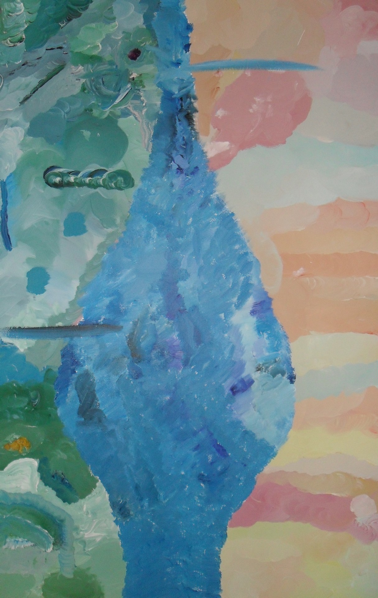


05/2010
acrylic on canvas
100 x 155 cm
for sale


English